

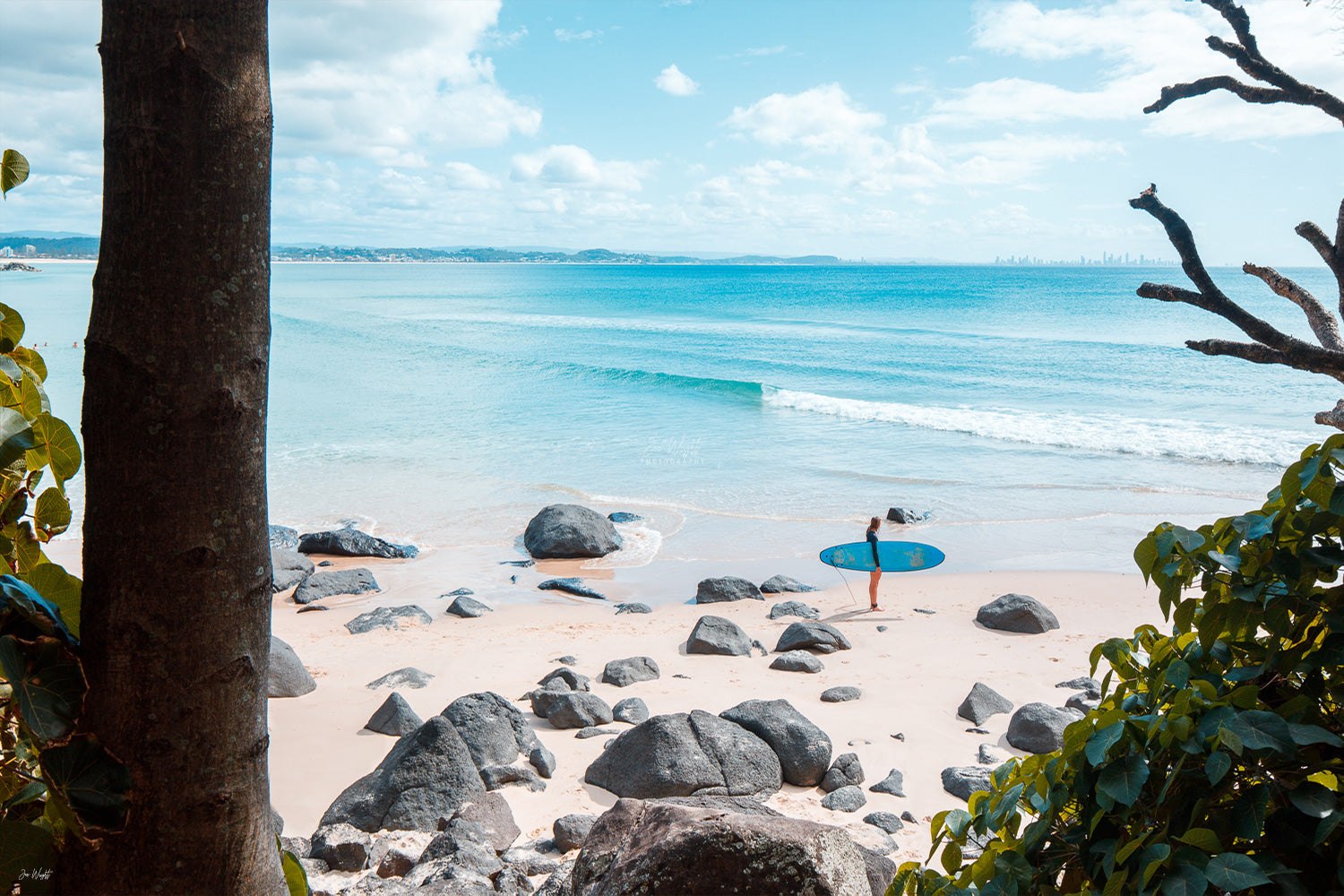
Most of what's written about buying surf photography online comes from print sellers who've never actually been in the water with a camera. I have, for years, swimming out at Duranbah, Snapper Rocks, Kirra and Burleigh Heads with a housing over my camera, timing sets and waiting for the right wave the same way the surfers around me were. One of those shots, Exit Wave, won overall winner at the 2010 Digital Camera World Photographer of the Year awards, plus first in the Adrenalin category, and later made the cover of Capture magazine's Australia's Top Emerging Photographers issue. That's the difference buying from someone who shoots the sport rather than just prints it: you're getting a genuine moment, not a stock composition.
What makes a surf photograph work as art
A good surf shot isn't just a wave, it's timing. Sometimes that's a surfer, the barrel closing in behind them, the split second of a duck dive. The Duck Dive is one of mine that still gets requested most, super clear water letting you see straight through the wave as the surfer rises. But surf art doesn't need a surfer in it at all, an empty wave at the exact moment it explodes, the spray peeling off the lip, is its own kind of timing and its own kind of art. Southern Gold, a top 10 finish in the Australian Surf Photographer of the Year awards, is a wave with nobody on it, just the water rearing and about to break. Webbed Hands is the same idea taken further, backwash off a rock wall caught at the instant it forms shapes like fingers. Neither needed a surfer to be a genuine surf photograph.

The Gold Coast breaks, and what each one gives you
Every break has its own character and its own kind of shot. Kirra and Duranbah are where the barrels happen, tight, powerful, and where a lot of my water shots come from, Inside Out at Kirra is a good example. Snapper Rocks is where the line-ups and the aerial perspective come into their own, Birds Eye Line Up shows the crowd and the wave from directly above. Burleigh Heads sits in between, both the barrel and the wider landscape, Burleigh Birds Eye captures that scale.

Choosing a piece
Decide first what you're after: the water level intensity of being in the wave with a surfer, like The Duck Dive or Inside Out at Kirra, an empty wave caught at its most dramatic moment, like Southern Gold or Webbed Hands, or the wider, calmer perspective of an aerial line-up shot. All three read very differently in a room, one is energy and motion, one is texture and timing, the other is pattern and scale. A number of these are also available in black and white if you want the same shot with less colour competing with the rest of your room.
Sizing and orientation
Most surf shots suit a landscape crop, above a sofa or along a hallway, aim for 60-75% of the available wall space, and two-thirds the width of any furniture it's hanging above. The aerial line-up shots often work as a panorama or square crop instead, similar to the aerial collection.
Framed, canvas or acrylic
Same rule as everywhere else in the shop: it depends on the room's light, not the image. Acrylic gives the most detail and depth but is reflective, so it wants a wall without direct glare. Canvas absorbs more light and suits a bright room. Framed is the traditional option, and pairing it with our non-reflective glass cuts down glare if that's a concern.
Where to start
The full range is in the Surf Art collection, 86 pieces spanning Snapper Rocks, Currumbin, Kirra, Burleigh Heads and Bondi Beach, in colour and black and white.


