

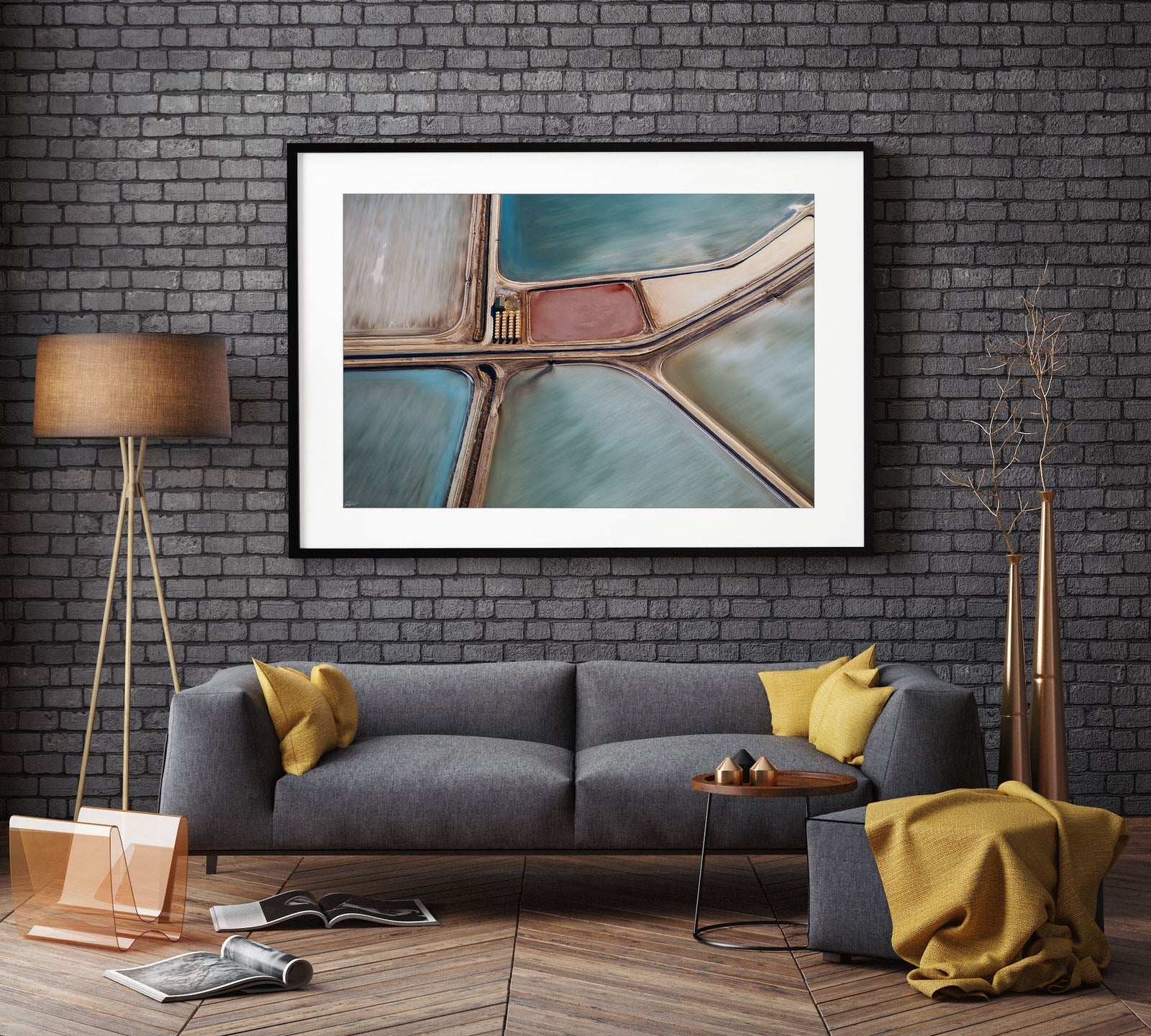
I've spent the better part of a decade shooting doors-off from helicopters and light aircraft up and down the Gold Coast, across Brisbane and out over the Whitsundays. It's a different way of seeing a place you think you already know, and it photographs differently to anything shot from the ground, which is why I get asked more questions about buying aerial prints than almost any other style in the shop. Here's what I'd tell you if you asked in person.
Why aerial works so well as wall art
From directly above, familiar places turn into pattern and colour. A wave becomes a line. A stretch of sand becomes texture. A city becomes geometry. Skyline Panorama, one of my recent Surfers Paradise shots, is a good example, the same coastline everyone's seen from the beach, but shot straight down it reads as an abstract composition first and a place second. That's the appeal: aerial prints tend to work as a genuine piece of art in a room, not just a photo of a nice view.

Choosing a subject
Coastline shots, Burleigh Heads, Snapper Rocks, Currumbin Alley, read as recognisable, grounded pieces, good if you want the location itself to mean something. City shots, the Story Bridge, the Brisbane river bends, lean architectural and suit a study or office. Then there's the genuinely abstract end of the range, patterns in the sand at Whitehaven Beach like Shark Impression and Snake Skin, along with the Western Australia salt lake and shark bay series, which read as pure shape and colour and suit a space where you want art first, location second.

Orientation and size
Aerial shots are often shot square or in a wide panorama rather than the usual landscape crop, which changes where they work in a room. A panorama like Skyline Panorama wants a long, uninterrupted run of wall, above a sofa or a dining table. Square crops sit well in tighter spaces or as part of a pair. As a general rule, aim for artwork to fill 60-75% of the available wall space, and if it's going above furniture, two-thirds the width of the piece below it.
Framed, canvas or acrylic
This one comes down to the room more than the image. Acrylic gives you the most detail and a real depth to the colour, but it's reflective, so it wants a wall that isn't fighting glare from a window or a light directly opposite it. Canvas absorbs more of the light hitting it, which makes it the better pick for a bright room or a wall that catches direct sun. Framed is the traditional, timeless option, and if you're worried about reflection but still want a frame, pairing it with our non-reflective glass cuts the glare right down. Have a look at the room itself before the image, that's what decides which one's right.

Where to start
The full range is in the aerial photography collection, the more graphic, pattern-led work is in Abstract Aerial Art, and the Gold Coast and Brisbane sets are broken out separately if you know the area you want on your wall.


